


Industrial Demand Side Management Market Overview
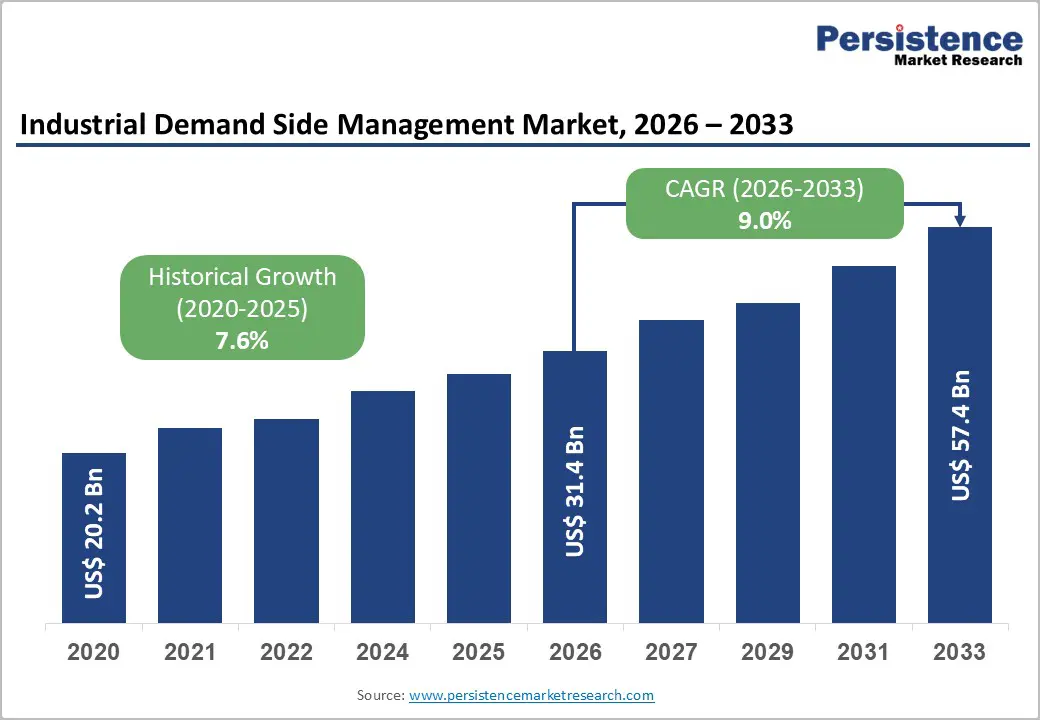
The global industrial demand side management (DSM) market size is expected to reach US$31.3 billion in 2026 and is projected to expand to US$57.4 billion by 2033, registering a CAGR of 9.0% between 2026 and 2033. The market is witnessing strong growth as industries worldwide prioritize energy efficiency, grid flexibility, carbon reduction, and operational cost optimization.
Industrial facilities across manufacturing, chemicals, metals, pharmaceuticals, food processing, and other energy-intensive sectors are increasingly adopting demand-side management solutions to monitor, control, and optimize electricity consumption. Rising industrial electricity prices, stricter decarbonization regulations, and growing renewable energy integration are encouraging companies to move from traditional energy consumption models toward intelligent, data-driven energy management.
The rapid adoption of Energy Management Systems (EMS), Advanced Metering Infrastructure (AMI), industrial IoT sensors, artificial intelligence (AI)-powered analytics, and automated demand response platforms is transforming how industries manage energy consumption. These technologies enable real-time monitoring, predictive optimization, and automated load adjustments while maintaining production efficiency.
Governments and utilities are also accelerating DSM adoption through demand response incentives, energy efficiency mandates, and smart grid modernization programs. Regulatory initiatives such as the U.S. Federal Energy Regulatory Commission (FERC) Order 2222, the European Union Energy Efficiency Directive, and India's Perform, Achieve and Trade (PAT) scheme are creating favorable market conditions for industrial DSM deployment.
Industrial Demand Side Management Market Key Highlights
✦ Market Size (2026): US$31.3 billion
✦ Forecast Market Size (2033): US$57.4 billion
✦ Market Growth Rate: CAGR of 9.0% from 2026 to 2033
✦ Leading Region: North America, supported by mature demand response markets and energy efficiency programs
✦ Fastest-Growing Region: Asia Pacific, driven by industrial expansion and smart meter deployment
✦ Dominant Technology Segment: Energy Management Systems (EMS), accounting for around 48% market share
✦ Fastest-Growing Technology: AI-powered EMS solutions enabling advanced energy optimization
✦ Major Opportunity: Expansion of AMI infrastructure and industrial IoT adoption worldwide
Key Growth Drivers of the Industrial Demand Side Management Market
Expansion of Utility Demand Response Programs and Grid Flexibility Initiatives
One of the strongest factors driving the industrial DSM market is the expansion of utility-led demand response programs. Electricity grids globally are undergoing significant transformation due to renewable energy integration, distributed generation, and increasing electricity demand from industrial and digital infrastructure.
Industrial consumers represent some of the largest flexible energy resources available to utilities. Through demand response programs, industries can temporarily reduce or shift electricity consumption during peak demand periods in exchange for financial incentives.
In the United States, FERC Order 2222 has enabled distributed energy resources, including industrial demand response assets, to participate in wholesale electricity markets. This regulatory shift has created new revenue opportunities for industrial facilities investing in automated DSM platforms.
According to the International Energy Agency (IEA), demand response could provide approximately 500–600 GW of global grid flexibility by 2030 under the Net Zero scenario. This growing need for flexible energy resources is expected to accelerate investments in industrial load management technologies.
Across Europe, the EU Energy Efficiency Directive and Electricity Regulation (EU) 2019/943 are encouraging industries to participate in demand-side flexibility markets. Similar initiatives are emerging across Asia Pacific as governments modernize electricity networks and promote renewable integration.
Rising Energy Costs and Industrial Decarbonization Targets Driving EMS Adoption
Energy-intensive industries are under increasing pressure to reduce operational expenses and carbon emissions. Electricity price volatility, carbon taxation, and corporate sustainability commitments are encouraging industrial organizations to implement advanced energy management solutions.
Industrial activities account for approximately 37% of global final energy consumption, according to the IEA, making energy efficiency improvements a critical component of global climate strategies.
Industrial DSM platforms help companies achieve energy savings through:
- Real-time energy monitoring
- Automated equipment optimization
- Peak load management
- Carbon emission tracking
- Predictive energy forecasting
- Renewable energy integration
The European Union’s Fit for 55 initiative, which targets a 55% reduction in greenhouse gas emissions by 2030, is encouraging industries to adopt advanced energy efficiency technologies.
Additionally, thousands of companies participating in the Science Based Targets initiative (SBTi) require accurate Scope 2 emissions measurement and reporting. Industrial DSM systems provide the data transparency required for achieving sustainability goals.
Market Restraints
High Initial Investment Costs
Despite significant long-term benefits, high upfront investment remains a major challenge for industrial DSM adoption. Large-scale implementations often require:
- Smart meter installation
- Industrial IoT sensors
- EMS software deployment
- SCADA integration
- Automation upgrades
- Cybersecurity infrastructure
For large industrial facilities, implementation costs can range from US$500,000 to more than US$5 million, depending on facility complexity and technology requirements.
Although DSM investments typically generate energy savings and operational improvements, payback periods can range from three to seven years. Smaller industrial companies with limited capital budgets may delay adoption due to financial constraints.
Cybersecurity Risks and OT/IT Integration Challenges
Industrial DSM systems require integration between operational technology (OT) environments and information technology (IT) networks. This connectivity enables real-time monitoring and automated energy control but also introduces cybersecurity concerns.
Industrial control systems, including:
- SCADA systems
- Programmable logic controllers (PLCs)
- Distributed control systems (DCS)
must be protected against cyber threats.
Organizations such as the U.S. Cybersecurity and Infrastructure Security Agency (CISA) continue to highlight industrial cybersecurity as a critical infrastructure priority.
Compliance requirements such as NERC CIP standards increase implementation complexity, requiring companies to invest in secure communication systems, access controls, and cybersecurity monitoring.
Industrial Demand Side Management Market Opportunities
AI-Powered Energy Management Systems Creating New Growth Opportunities
Artificial intelligence is emerging as one of the most transformative technologies in the industrial DSM market. AI-powered EMS platforms can analyze large volumes of energy consumption data and automatically identify optimization opportunities.
Leading solutions from companies such as:
- Schneider Electric EcoStruxure
- Siemens MindSphere
- C3.ai Energy Management Platform
use machine learning algorithms to forecast demand, detect inefficiencies, and optimize energy usage.
According to U.S. Department of Energy case studies, AI-based energy management systems can deliver 10–25% additional energy savings compared with traditional energy management approaches.
AI-enabled DSM solutions are particularly valuable in industries with complex energy profiles, including:
- Chemical processing
- Steel manufacturing
- Automotive production
- Semiconductor manufacturing
The adoption of Energy-as-a-Service (EaaS) models is further accelerating AI-EMS deployment by allowing companies to access advanced technologies without large upfront investments.
Advanced Metering Infrastructure Creating Market Expansion Potential
The global expansion of smart meters is creating a strong foundation for industrial DSM growth.
The United States has already installed more than 115 million smart meters, providing extensive electricity consumption data for advanced analytics and demand response applications.
The European Union’s Smart Metering Directive aims for approximately 80% smart meter penetration, supporting industrial energy monitoring initiatives.
India’s Smart Meter National Programme (SMNP) targeting 250 million smart meter installations is creating significant opportunities for DSM providers.
AMI infrastructure enables:
- Real-time energy measurement
- Automated demand response
- Remote load management
- Data-driven energy optimization
As smart meter deployment expands, demand for EMS software, analytics platforms, and industrial demand response solutions is expected to increase significantly through 2033.
Industrial Demand Side Management Market Segment Analysis
Service Segment Analysis
Energy Efficiency Services Lead the Market
Energy efficiency services represent the leading service segment, accounting for approximately 42% market share in 2026.
These services include:
- Industrial energy audits
- Equipment efficiency improvements
- Motor optimization
- Compressed air system upgrades
- Lighting efficiency programs
- Process optimization
The U.S. Department of Energy’s Industrial Assessment Centers have conducted more than 20,000 industrial assessments, identifying opportunities that commonly deliver 12–20% energy savings.
The increasing adoption of ISO 50001 Energy Management Systems is also supporting demand for professional energy efficiency services worldwide.
Technology Segment Analysis
Energy Management Systems Hold Dominant Market Share
Energy Management Systems (EMS) represent the largest technology segment, accounting for approximately 48% market share in 2026.
Industrial EMS platforms provide centralized control and visibility across:
- Manufacturing equipment
- HVAC systems
- Process heating systems
- Compressed air systems
- Electrical infrastructure
Companies including:
- Schneider Electric
- Siemens
- Honeywell
- Johnson Controls
- Eaton
offer advanced EMS solutions integrated with industrial automation platforms.
The growing requirement for ISO 50001 compliance and continuous energy improvement is expected to maintain EMS leadership throughout the forecast period.
Regional Analysis
North America Industrial DSM Market Trends
North America dominates the global industrial DSM market due to advanced grid infrastructure, mature demand response programs, and strong government support.
The region benefits from:
- FERC-regulated demand response markets
- DOE energy efficiency initiatives
- Utility incentive programs
- Industrial smart meter adoption
The United States represents approximately 80% of North America's industrial DSM market revenue.
The DOE Better Plants Program, involving more than 250 industrial partners representing 14% of U.S. manufacturing energy use, continues to support industrial energy efficiency improvements.
Europe Industrial DSM Market Outlook
Europe represents the second-largest industrial DSM market, driven by aggressive climate policies and energy efficiency regulations.
Major growth factors include:
- EU Energy Efficiency Directive
- Fit for 55 climate framework
- EU Emissions Trading System
- REPowerEU initiative
Germany leads the European market, accounting for approximately 24% share in 2025, supported by its large chemical, automotive, and manufacturing industries.
The United Kingdom and France are also experiencing strong DSM adoption due to demand flexibility programs and industrial carbon reduction policies.
Asia Pacific Industrial DSM Market Growth
Asia Pacific is expected to register the fastest growth through 2033 due to rapid industrialization, government efficiency programs, and smart grid investments.
China Industrial DSM Market
China accounts for approximately 46% of Asia Pacific industrial DSM revenue.
Growth is supported by:
- 14th Five-Year Plan energy efficiency targets
- Industrial decarbonization programs
- State Grid smart meter deployment
- Provincial demand response initiatives
China’s industrial DSM market is projected to grow at approximately 10.2% CAGR through 2033.
India Industrial DSM Market
India represents around 14% of Asia Pacific industrial DSM revenue.
The BEE Perform, Achieve and Trade (PAT) scheme is driving DSM adoption across:
- Steel
- Cement
- Textile
- Chemical industries
Japan Industrial DSM Market
Japan’s industrial DSM growth is supported by the Energy Conservation Act and METI’s Green Innovation Fund initiatives.
Competitive Landscape
The industrial DSM market features competition between global automation leaders and specialized energy technology providers.
Major companies include:
- Schneider Electric
- Siemens AG
- Honeywell International
- Johnson Controls
- Eaton Corporation
- ABB Ltd.
- Emerson Electric
- General Electric
- IBM Corporation
- Rockwell Automation
- C3.ai
- Itron Inc.
- Landis+Gyr
- Optimum Energy
- eSight Energy
Companies are increasingly focusing on AI integration, cloud-based platforms, cybersecurity solutions, and Energy-as-a-Service business models.
Future Outlook of the Industrial Demand Side Management Market
The industrial demand side management market is entering a new phase of digital transformation driven by AI, IoT, smart grids, and sustainability requirements.
Between 2026 and 2033, industrial organizations will increasingly adopt intelligent DSM platforms to reduce energy costs, improve operational efficiency, and meet carbon reduction targets.
The combination of government incentives, renewable energy expansion, smart meter deployment, and AI-powered optimization will create significant growth opportunities for technology providers and industrial users.
With the market expected to grow from US$31.3 billion in 2026 to US$57.4 billion by 2033, industrial DSM will become a critical component of global energy transition strategies, enabling industries to achieve greater efficiency, flexibility, and sustainability.

 English
 Arabic
 French
 Spanish
 Portuguese
 Turkish
 Dutch
Dutch
 Italiano
 Russian
 Romaian
 Portuguese (Brazil)
 Greek
Greek