


Have you been told to write an assignment involving evidence-based practice, and now you’re spending hours staring at your work and wondering, ‘Would these sources be reliable enough to support my arguments and earn good assignment grades?’
Let me tell you that you are not the only one to feel puzzled, as many students struggle to integrate the best current information, clinical practices, and patient care values, which is why their assignments lack strong academic support and they score poorly.
If you don’t want to make such mistakes and lose marks, you must learn how to incorporate evidence-based practice in midwifery assignments. With this approach, you can improve your assignment’s quality and prepare yourself to make informed decisions in real-life clinical situations where you have to provide efficient care to both the mother and the newborn.
You don’t have to feel stressed if you are confused about evidence-based practice, finding credible evidence, or writing your assignment with this approach.
This comprehensive post explains everything you need to know about evidence-based practice, why it matters for your midwifery assignments, and what most evidence-based practice midwifery assignments include.
Buckle up and let’s get started!
First Things First: What is Evidence-Based Practice?
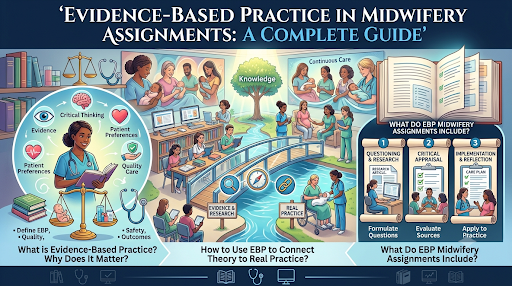
Evidence-based practice in the midwifery field is a problem-solving method you, as a student, use to make clinical and academic decisions, using current research, clinical experience, and women’s preferences.
Before you begin writing your assignment, you must understand this in detail, and if you are still confused, let me clarify:
-
You will have to find the best available research evidence.
-
Use your knowledge from the clinical experience of healthcare professionals.
-
Consider the values, preferences, and needs of women and their families.
Simply put, you are required to use trustworthy scientific research to make care decisions rather than personal opinions and assumptions. It helps you ensure that both mother and baby receive safe, effective care based on evidence from up-to-date research.
How Can You Use EBP to Connect Theory to Real Practice?
Do you know that one of the most important aspects of Evidence-Based Practice (EBP) is that it involves linking your learned theories with real clinical scenarios? That means, instead of simply describing a concept in your midwifery assignment, you must know how to explain these:
-
First, what the research says about a particular situation.
-
Then, find out how you can apply that research to midwifery care.
-
Explain why it matters for the mother and the baby in a certain situation.
With this approach, you can demonstrate your in-depth understanding and improve the value and quality of your assignment.
Why Does Evidence-Based Practice In Midwifery Matter?
For your midwifery assignments, applying the evidence-based practice (EBP) approach to your work is crucial, as it can help you bridge the gap between your textbook theories and midwifery practices, too, by excluding the outdated traditions to ensure you provide scientifically valid care.
Given its importance, it’s fair to say that evidence-based practice is the foundation of modern midwifery. Here is a brief explanation for you if you are wondering, ‘Why does evidence-based practice actually matter in midwifery studies?’
-
You get to strengthen your understanding of maternal and neonatal safety
Since EBP is among the healthcare approaches that directly lead to better health outcomes, applying evidence-based practice in your midwifery studies can help you reduce unnecessary interventions and complications. Therefore, your midwifery assignments should prove how your decisions can protect the health of both mother and baby.
-
You can be prepared for real-world clinical practice
As you begin your career as a midwife, almost every modern healthcare organisation requires you to base your care on rigorous research. This is why, for your midwifery assignments, you have to develop your ability to translate the latest scientific research into everyday solutions for better maternity care.
-
It helps you develop critical thinking skills
Using evidence-based practice in your studies can help ensure you are not simply memorising textbook concepts. Instead, you can learn how to conduct routine procedures, analyse complex midwifery scenarios, and make informed decisions using objective data.
-
You can improve academic quality
Applying EBP in your complex midwifery assignments and other coursework can help you support your ideas with strong research rather than using your personal opinions or assumptions. As a result, you can achieve academic excellence by making your content authentic and following the academic standards of UK universities.
-
It boosts your confidence in assignment writing
This is very simple. When you are fully aware of how you can use your research properly in your work, it becomes easier for you to feel confident in structuring your arguments in a more logical flow. All in all, this approach can help you ensure that the solutions and care decisions you make as a midwife are based on clinical expertise and the best current research.
What Do Evidence-Based Practice Midwifery Assignments Include?
Generally, evidence-based practice midwifery assignments require you to evaluate clinical decisions by formulating the clinical question, finding quality evidence, evaluating the research, applying the research to midwifery practice, and structuring your arguments clearly.
The following elements are commonly expected in evidence-based midwifery assignments.
Understanding the Assignment Question
You might be thinking, ‘How is understanding the assignment question related to evidence-based practice?’ Let me clarify that misunderstanding your assignment prompt can lead you to make errors while writing your midwifery assignment without realising it.
What I mean is, many students fail to notice the important instructions, including analyse, evaluate, compare, justify, and discuss. These are action words that shape your assignment writing approach.
To grasp every important detail from your brief, you should break it into smaller parts, and it's better to work through each requirement one by one.
Finding High-Quality Evidence
You must remember that strong assignments begin with strong evidence, so rely on the following research materials:
-
Trusted, peer-reviewed journal articles.
-
Systematic reviews and meta-analyses.
-
University library databases.
-
Specialised databases, such as PubMed or CINAHL (Cumulative Index to Nursing and Allied Health Literature).
-
Guidelines from the National Institute for Health and Care Excellence (NICE).
-
Renowned healthcare organisations, such as the Nursing and Midwifery Council (NMC).
Evaluating Your Research Critically
You must remember that finding research is only the first step of your assignment, and you will have to explain why one source is stronger than another. To evaluate your research critically, you should ask yourself the following questions:
-
Was this study conducted fairly?
-
Was this sample size large enough?
-
Were there any limitations?
-
Can I apply these findings to current midwifery practice?
Applying Research to Clinical Practice
Suppose you have to discuss delayed cord clamping. Here, using evidence-based practice will require you to explain how the latest evidence supports its benefits for the newborn’s health and why you will recommend it in certain situations as a midwife rather than just describing the procedure.
When you connect your theory and practice, you can demonstrate your understanding of evidence-based practice in midwifery and apply research to realistic midwifery scenarios.
Structuring Your Assignment Clearly
Let me tell you a fact: even your excellent research-based assignment can lose impact and increase your chances of lower marks if you have overlooked the poor organisation of your content.
To maintain a clear structure in your evidence-based midwifery assignment, you must take care of the following:
-
Introduction
Prepare a proper introduction by summarising your topic and outlining what your assignment will discuss.
-
Main Body
For your assignment’s main body, you will have to present your arguments supported by credible evidence and also ensure that each paragraph focuses on one idea from your research.
A helpful paragraph structure:
-
Supports your evidence.
-
Includes your critical analysis.
-
Applies your clinical knowledge to real-life situations.
By using this format, you can keep your writing organised, logical, and coherent.
-
Conclusion
For the conclusion, you will have to summarise your key findings and ensure that you don’t introduce any new information, as it can confuse the reader. So, briefly explain what your key findings and discussion have demonstrated throughout your content.
Using Referencing Correctly
This is important.
Referencing is a major reason why many students lose marks. So, you must cite each of your ideas that you have taken from another source correctly, and that too, according to your university’s preferred referencing style, such as Harvard or APA.
-
Make sure to give credit to the original researchers in your work.
-
You should also use reference management software to save time when you have to organise your citations and bibliographies.
Practical Tips to Improve Your Midwifery Assignments
To write a high-quality midwifery assignment, you can take smart notes, begin your research early to explore various academic sources, create an outline for better content organisation, and proofread your work.
Don’t know how to implement these? Don’t worry, as I have explained how to apply these tips to your work:
Start Your Research Early
When you begin your research early rather than leaving it until the last minute, it can give you enough time. It enables you to:
-
Conduct efficient research using a wide range of credible academic sources.
-
Prepare a comparative analysis on a specific issue using different studies and perspectives.
-
Get more time to understand complex topics clearly.
-
Avoid rushing the assignment-writing process.
Take Smart Notes Instead of Highlighting Everything
Have you seen your fellows highlighting large sections of text but struggling to use them later? That’s exactly why it is always better to write short summaries of every concept in your own words and note the key findings and conclusions from your research.
Moreover, to use a smarter approach while taking your notes, you should carefully record why the evidence is useful for your topic. It can not only save time when you are writing, but also help you understand the research in more depth.
Create a Clear Assignment Outline
You should always plan your structure before you start writing, as it will help you stay focused and organised.
For an outline, you can include:
-
Introduction points.
-
The main arguments and themes of your assignments.
-
The evidence for each section of your content.
-
A logical order of your ideas.
-
The summary points for your assignment’s conclusion.
Proofread Your Work
You must understand that proofreading is not just about fixing spelling mistakes. Instead, you are required to ensure everything from images and title to content and references is correct, relevant, and accurate.
Here’s what you should do when proofreading your content:
-
Use the read-aloud method to catch awkward phrasing and remove unclear sentences.
-
Identify grammar, spelling, and sentence structure mistakes
-
Read your content again to improve your content’s overall flow and maintain clarity.
Frequently Asked Questions
What is evidence-based practice in midwifery assignments?
For your midwifery assignments, evidence-based practice means using the best credible research, your professional midwifery knowledge, and considering women’s preferences to support your care decisions. It helps you strengthen your arguments.
How do I find reliable sources for my midwifery assignment?
You can start by searching the university library databases, peer-reviewed journal articles, healthcare organisations, and official publications. Then, avoid relying on blogs or unverified websites because they may contain outdated information that can weaken your academic arguments.
Why is critical analysis important in midwifery assignments?
By using critical analysis, you can evaluate research instead of simply describing it to compare studies and discuss their strengths and weaknesses. It can help you demonstrate your higher-level thinking and make your assignment more convincing.
How can I improve my marks in evidence-based midwifery assignments?
For that, you have to read your assignment brief carefully, plan your structure, conduct high-quality research, cite your references correctly, and proofread thoroughly. With these, you can create an organised assignment and achieve academic excellence.
What are the most common mistakes students make in midwifery assignments?
Among the common mistakes are using unreliable sources, misunderstanding the assignment brief, poor referencing, and describing evidence without conducting an analysis. By avoiding these mistakes, you can reduce your chances of losing marks.
The Final Word
Writing your midwifery assignment can be easier when you are aware of how to use research effectively, select trustworthy sources to analyse evidence, and apply your midwifery knowledge to real scenarios.
By developing these skills and applying evidence-based practice in midwifery, you can achieve better grades, improve your academic excellence, and also enhance your ability to conduct evidence-based midwifery practice throughout your career.
Moreover, applying this approach in your coursework can help you ensure that your midwifery assignments are based on relevant, credible, and the best recent research evidence.
Good luck with applying evidence-based practice to your academic coursework!

 English
 Arabic
 French
 Spanish
 Portuguese
 Turkish
 Dutch
Dutch
 Italiano
 Russian
 Romaian
 Portuguese (Brazil)
 Greek
Greek