


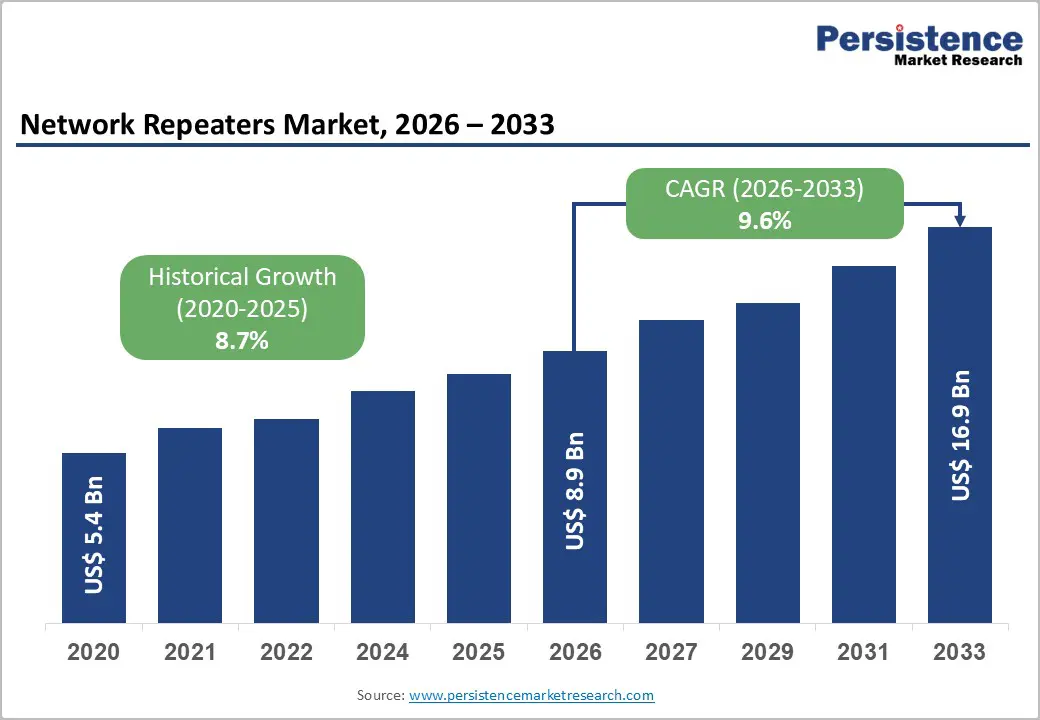
The global network repeaters market is witnessing strong expansion as demand for reliable, high-speed connectivity continues to accelerate across telecom, enterprise, industrial, and consumer environments. The market is valued at USD 8.9 billion in 2026 and is projected to reach USD 16.9 billion by 2033, growing at a CAGR of 9.6% during the forecast period from 2026 to 2033.
The increasing deployment of 5G networks, rising mobile data consumption, rapid IoT adoption, and growing demand for seamless wireless coverage are among the major factors supporting market growth. Network repeaters play a critical role in improving signal strength by receiving weak signals and retransmitting them at higher power levels, helping eliminate connectivity gaps in both urban and remote areas.
According to the International Telecommunication Union (ITU), approximately 2.7 billion people worldwide still lack internet access, creating significant opportunities for telecom infrastructure expansion. Governments and network operators are investing heavily in broadband connectivity programs, rural digital inclusion initiatives, and smart city projects, further increasing the demand for cost-effective signal amplification solutions.
Network repeaters are becoming essential components of modern communication infrastructure as businesses and consumers increasingly depend on uninterrupted connectivity for cloud applications, remote work, connected devices, digital healthcare, and industrial automation.
Network Repeaters Market Growth Drivers
Rapid 5G Deployment and Network Densification Accelerating Demand
The expansion of 5G networks is one of the most important growth drivers for the global network repeaters market. Unlike previous generations of mobile technology, 5G relies heavily on higher-frequency spectrum bands that provide faster speeds but experience greater signal attenuation and shorter transmission distances.
To overcome these limitations, telecom operators are deploying extensive networks of small cells, distributed antenna systems, and advanced repeaters to improve coverage and capacity. Dense urban environments, commercial buildings, transportation hubs, and industrial facilities require additional signal amplification infrastructure to ensure consistent connectivity.
According to GSMA, 5G connections are expected to account for approximately 54% of global mobile connections by 2030, compared with around 17% in 2023. This rapid transition is creating substantial opportunities for manufacturers of 5G-compatible repeaters.
Countries including the United States, China, South Korea, Japan, and European Union members are investing significantly in 5G infrastructure development. These investments are expected to generate long-term demand for advanced network repeater solutions capable of supporting next-generation wireless networks.
Increasing Mobile Data Traffic and Demand for In-Building Connectivity
The continuous increase in mobile data consumption is another major factor driving market growth. The rapid adoption of video streaming platforms, cloud computing services, online gaming, augmented reality applications, and connected devices has placed significant pressure on existing network infrastructure.
According to industry estimates, global mobile data traffic continues to grow rapidly due to increasing smartphone penetration and the expansion of digital services. Many buildings, including hospitals, airports, office complexes, shopping centers, and educational institutions, experience weak indoor signals because of concrete structures, glass coatings, and other construction materials.
As a result, organizations are increasingly deploying indoor network repeaters to provide reliable connectivity throughout large facilities.
Regulatory requirements are also supporting adoption. In the United States, the Federal Communications Commission (FCC) has introduced regulations requiring improved in-building wireless coverage for emergency communication systems. These requirements are encouraging the installation of advanced repeater solutions in public safety environments.
Network Repeaters Market Restraints
Regulatory Compliance and Certification Challenges
Despite strong growth opportunities, the market faces challenges related to regulatory compliance and certification requirements. Network repeaters must comply with standards established by organizations such as the FCC, European CE certification authorities, and regional telecommunications regulators.
Improperly configured repeaters can create signal interference, affecting network performance for other users. As a result, manufacturers must conduct extensive testing and obtain approvals before commercial deployment.
These compliance requirements increase product development costs and extend deployment timelines. Smaller companies may face difficulties managing certification processes, limiting market participation in certain regions.
Signal Interference and Compatibility Issues
Technical challenges associated with signal interference and network compatibility also impact market expansion. Traditional analog repeaters may create performance issues when deployed in highly congested radio frequency environments.
The transition toward 5G networks and heterogeneous network architectures requires repeater manufacturers to develop advanced solutions compatible with modern telecom standards.
Continuous upgrades in technologies such as 5G New Radio (NR), Open RAN, and software-defined networking increase research and development investments for manufacturers. Complex installation requirements in urban environments can also increase operational costs.
Opportunities in the Network Repeaters Market
Growth of Smart and Digital Repeaters
The shift from traditional analog repeaters toward digital and smart repeaters represents a significant growth opportunity. Smart repeaters incorporate advanced features such as remote monitoring, automatic optimization, artificial intelligence-based analytics, and cloud management capabilities.
Telecom operators are increasingly adopting intelligent repeater solutions to reduce maintenance costs, improve network performance, and enhance customer experience.
Smart repeater technologies aligned with Open RAN architectures are expected to gain momentum as operators move toward flexible and software-driven network infrastructure.
Countries such as South Korea and Japan are actively investing in advanced repeater technologies as part of their national 5G strategies.
IoT Expansion and Smart Infrastructure Development
The rapid growth of IoT applications is creating new opportunities for network repeater deployments. Smart manufacturing, connected healthcare, precision agriculture, smart utilities, and autonomous transportation require reliable wireless connectivity across large geographic areas.
According to IDC, global IoT connections are expected to exceed 55 billion devices, creating significant demand for network infrastructure capable of supporting massive connectivity requirements.
Emerging economies across Asia Pacific, Latin America, and Africa are investing in rural broadband initiatives where repeaters provide a cost-effective alternative to building extensive tower infrastructure.
Network Repeaters Market Segment Analysis
Product Type Insights
Wi-Fi Repeaters Dominate the Market
Wi-Fi repeaters represent the leading product segment, accounting for approximately 38% market share in 2025. Their dominance is driven by widespread adoption across residential, commercial, and enterprise environments.
The increasing popularity of smart homes, remote working models, and connected devices has created strong demand for improved indoor wireless coverage.
The introduction of Wi-Fi 6E and Wi-Fi 7 technologies is further supporting segment growth by increasing demand for advanced repeaters capable of operating on higher-frequency bands.
Cellular Repeaters Witness Strong Growth
Cellular repeaters are projected to grow rapidly due to increasing demand for improved mobile coverage in large buildings, public venues, and industrial facilities.
The deployment of 5G networks and government requirements for better emergency communication coverage are expected to accelerate adoption.
Deployment Analysis
Indoor Repeaters Lead the Market
Indoor repeaters account for approximately 52% of the market share in 2025, making them the dominant deployment segment.
Commercial buildings, hospitals, universities, airports, and enterprise campuses increasingly require reliable indoor connectivity due to rising dependence on digital services.
Companies such as CommScope and Corning are developing advanced indoor connectivity solutions combining repeaters with distributed antenna systems (DAS).
Mobile Repeaters Gain Momentum
Mobile repeaters are expected to experience strong growth through 2033, supported by demand from emergency response vehicles, transportation systems, maritime applications, and remote operations.
These solutions enable reliable connectivity in areas where fixed infrastructure is unavailable.
Technology Analysis
4G/LTE Repeaters Maintain Market Leadership
4G/LTE repeaters currently dominate the technology segment with approximately 41% market share in 2025.
Although 5G adoption is increasing, LTE networks continue to support billions of users globally, particularly across developing regions.
Telecom operators continue upgrading LTE infrastructure to maximize existing investments, maintaining steady demand for LTE repeater solutions.
5G NR Repeaters Show Fastest Growth
5G NR repeaters represent the fastest-growing technology segment, expanding at a projected CAGR of 22.4% through 2033.
Growing private 5G deployments across manufacturing, logistics, healthcare, and industrial automation are creating strong demand for next-generation repeater technologies.
Regional Outlook
North America Leads the Global Market
North America holds the largest share of the network repeaters market, accounting for approximately 34% of global revenue in 2025.
The region benefits from advanced 5G infrastructure, strong telecom investments, and strict requirements for indoor public safety coverage.
The United States represents the largest market within North America, supported by investments from operators such as Verizon, AT&T, and T-Mobile.
Federal broadband expansion programs, including the Infrastructure Investment and Jobs Act, are also supporting repeater deployment in underserved rural communities.
Asia Pacific Emerges as the Fastest-Growing Region
Asia Pacific is expected to grow at the fastest pace, with a projected CAGR of 11.3% through 2033.
China, India, South Korea, and Southeast Asian countries are driving regional growth through large-scale 5G deployment and digital transformation programs.
China leads the regional market due to its massive 5G infrastructure network, while India presents significant growth potential through initiatives such as BharatNet and nationwide broadband expansion programs.
South Korea’s advanced 5G ecosystem and smart factory development are also increasing demand for specialized repeater solutions.
Competitive Landscape
The network repeaters market is moderately consolidated, with major companies focusing on technological innovation, partnerships, and expansion of smart connectivity solutions.
Leading market players include:
- CommScope
- Huawei
- ZTE
- Ericsson
- Corning Incorporated
- Advanced RF Technologies
- Wilson Electronics
- Comba Telecom
Companies are investing in AI-powered repeaters, Open RAN compatibility, cloud-based monitoring platforms, and software-defined solutions to strengthen their market position.
Strategic partnerships with telecom operators and infrastructure providers remain a key competitive strategy.
Future Outlook of the Network Repeaters Market
The global network repeaters market is expected to experience sustained growth through 2033 as digital connectivity becomes increasingly essential across industries.
The combination of 5G expansion, IoT adoption, smart city development, and rural broadband initiatives will continue creating new demand opportunities.
Future growth will be driven by intelligent repeater technologies capable of self-optimization, remote management, and integration with next-generation communication networks.
As businesses, governments, and consumers require faster and more reliable connectivity, network repeaters will remain a critical component of global communication infrastructure.
With the market projected to grow from USD 8.9 billion in 2026 to USD 16.9 billion by 2033, network repeaters are positioned as a key technology enabling the next phase of global digital transformation.

 English
 French
 Spanish
 Portuguese
 Deutsch
 Turkish
 Dutch
Dutch
 Italiano
 Russian
 Romaian
 Portuguese (Brazil)
 Greek
Greek