


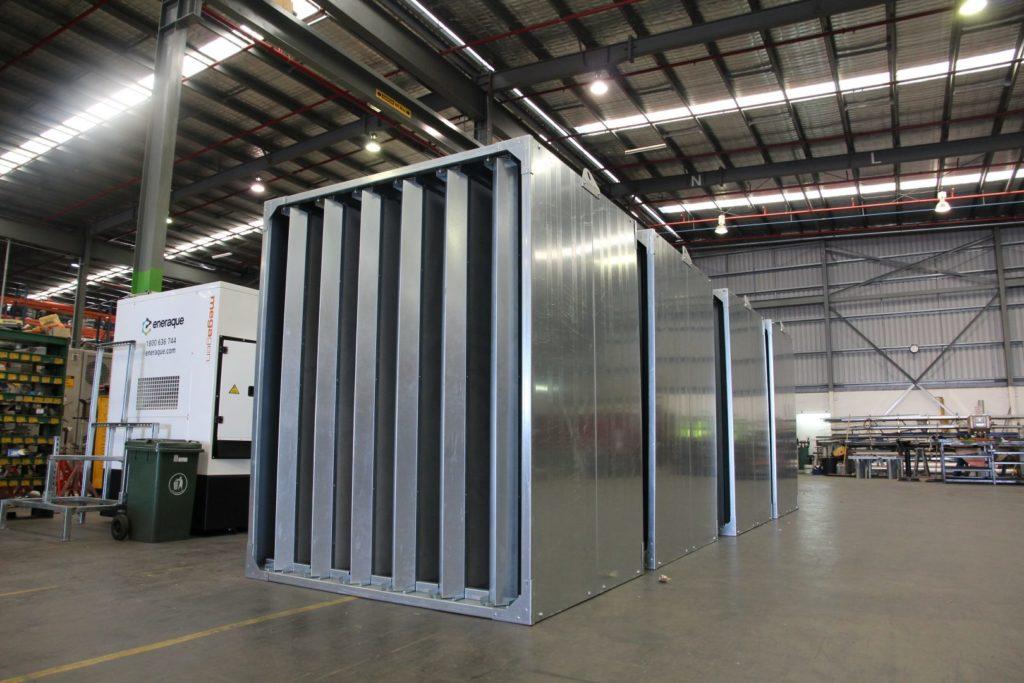
Every plant has that one sound nobody talks about until a complaint lands on someone's desk — the roar from an HVAC exhaust, a compressor discharge, or a boiler stack. Industrial silencers are the quiet fix for that loud problem, and they're doing more work in Indian factories today than most people realize.
What Industrial Silencers Actually Do
Industrial silencers, also called sound attenuators, are engineered devices installed inline with air or gas flow paths to reduce noise generated by moving air, exhaust gases, or mechanical vibration. They're used wherever a duct, pipe, or vent would otherwise act as a megaphone for machinery noise — HVAC systems, compressor rooms, boiler stacks, and turbine exhausts are the most common spots.
Unlike a simple enclosure that blocks sound from escaping a room, industrial silencers work directly inside the airflow path itself, using absorptive baffles or reactive chambers to dampen sound waves without restricting airflow more than necessary.
Why Airflow Matters as Much as Noise Reduction
A poorly designed silencer can solve a noise problem and create an airflow problem in its place. If a unit restricts flow too much, it increases backpressure, strains fans or blowers, and can even reduce equipment efficiency. Good industrial silencers are engineered to balance two competing goals: maximum acoustic attenuation with minimum pressure drop. This is where careful baffle spacing, airflow modeling, and material selection make the real difference between a functional unit and one that just looks like a solution on paper.
Common Types Used in Industry
- Dissipative silencers — use absorptive material like mineral wool inside perforated baffles, ideal for HVAC and ventilation ducts
- Reactive silencers — use chamber geometry to cancel out specific sound frequencies, common in engine exhaust and compressor discharge lines
- Combination silencers — blend both approaches for broadband noise reduction across a wider frequency range
Choosing between them depends on the noise frequency profile of the source equipment, which is why proper acoustic assessment before installation matters more than picking a unit off a catalog page.
Where They're Used Across Industry
Industrial silencers show up in more places than people expect:
- HVAC intake and exhaust systems in commercial and industrial buildings
- Compressor and blower discharge lines
- Boiler and furnace stacks
- Cooling tower and chiller ventilation systems
- Gas turbine and engine exhaust paths
Hospitals, data centers, and residential-adjacent industrial sites tend to have the strictest requirements, since community noise complaints can trigger regulatory action fast.
Choosing a Manufacturer That Understands Both Acoustics and Airflow
Not every fabricator working with sheet metal and insulation can properly engineer a silencer — it requires acoustic modeling alongside airflow and pressure-drop calculations. Ecotone Systems manufactures sound attenuators as part of a broader industrial noise control portfolio, applying the same acoustic engineering background used across their enclosures and noise barrier products. That kind of integrated expertise tends to matter once a unit is running continuously in a live plant environment, not just during a lab test.
Manufacturers like Ecotone Systems, with experience across HVAC, compressor, and turbine applications, are generally better equipped to size and configure a silencer correctly for the specific noise spectrum of the source equipment — rather than offering a generic unit that underperforms on-site.
The Bottom Line
Industrial silencers rarely get attention until they're missing or undersized, but they play a direct role in regulatory compliance, worker health, and community relations around industrial sites. Getting the acoustic and airflow engineering right the first time — ideally with an experienced partner like Ecotone Systems — saves plants from costly retrofits and repeat noise complaints down the line.

 English
 Arabic
 French
 Spanish
 Portuguese
 Turkish
 Dutch
Dutch
 Italiano
 Russian
 Romaian
 Portuguese (Brazil)
 Greek
Greek