


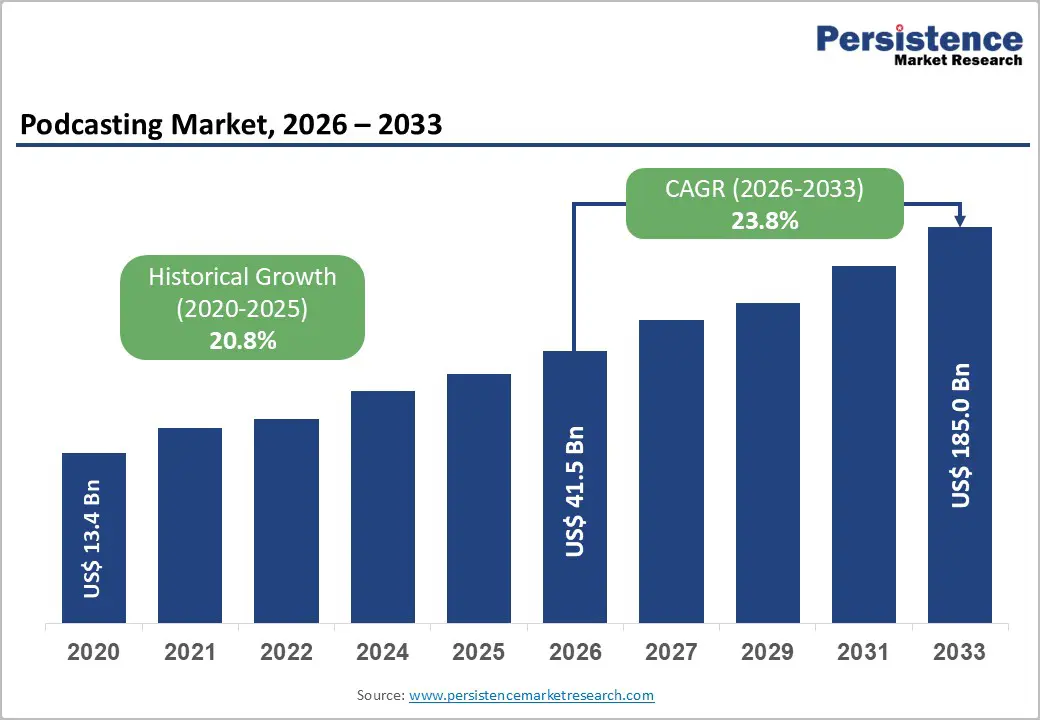
The global podcasting market is entering a high-growth phase as consumers increasingly shift from traditional broadcast media toward convenient, on-demand audio and video content. The global podcasting market size is expected to reach US$ 41.5 billion in 2026 and is projected to expand to US$ 185.0 billion by 2033, registering a CAGR of 23.8% between 2026 and 2033.
The market's rapid expansion is being supported by rising podcast listenership, growing smartphone and connected-device penetration, increasing digital advertising budgets, and the integration of podcasts into smart speakers, connected cars, and mobile entertainment ecosystems. Younger audiences, in particular, are embracing podcasts as an alternative to traditional radio and television.
Podcasting is also evolving beyond audio. The increasing popularity of video podcasts on platforms such as YouTube and Spotify is creating new monetization opportunities for creators, publishers, advertisers, and technology providers. At the same time, artificial intelligence (AI) is reducing production costs through automated editing, transcription, translation, dubbing, and content enhancement.
Podcasting Market Overview
Podcasting has transitioned from a niche digital-media format into a mainstream entertainment, education, news, and advertising channel. An estimated 135 million Americans aged 12 and older have listened to a podcast, demonstrating the substantial scale of the medium.
The expansion of mobile broadband, affordable smartphones, and easy access to streaming platforms has significantly lowered barriers to podcast consumption. Spotify, Apple Podcasts, Amazon Music, YouTube, iHeartMedia, and other platforms are competing to attract listeners and creators while developing new monetization models.
The global podcasting market is expected to increase from US$ 41.5 billion in 2026 to US$ 185.0 billion by 2033, representing an incremental opportunity of approximately US$ 143.5 billion during the forecast period.
Key Market Highlights
- Market Size in 2026: US$ 41.5 billion
- Projected Market Size in 2033: US$ 185.0 billion
- CAGR: 23.8% from 2026 to 2033
- Leading Region: North America, with approximately 41% revenue share in 2026
- Fastest-Growing Region: Asia Pacific, with CAGR above 27%
- Leading Format: Interviews, with approximately 38% share
- Leading Genre: Society & Culture, with approximately 23% share
- Major Opportunity: Video podcasting and cross-platform distribution
Key Drivers of the Podcasting Market
Surging Listener Base and Mobile-First Consumption
The expanding global listener base is one of the most important factors supporting podcasting market growth. Consumers increasingly prefer flexible, on-demand media that can be accessed while commuting, exercising, working, or performing household activities.
In the United States, approximately 47% of people aged 12 and older report listening to podcasts monthly, representing significant growth from previous years. Podcast consumption is also expanding across Europe, Asia Pacific, Latin America, and other emerging markets.
Smartphones have been particularly important in expanding podcast accessibility. The widespread availability of 4G and 5G networks allows users to stream or download episodes almost anywhere. Platforms such as Spotify, Apple Podcasts, Amazon Music, and YouTube have simplified discovery and consumption through personalized recommendations and curated playlists.
Connected cars and smart speakers are further expanding listening occasions. As podcast applications become integrated into vehicle infotainment systems, consumers can seamlessly transition from mobile listening to in-car consumption.
Increasing Podcast Advertising Spending
Advertising is another major growth engine. Brands are increasingly shifting budgets from traditional radio toward digital audio because podcast advertising provides access to highly engaged and targeted audiences.
Podcast advertising is particularly attractive because of the effectiveness of host-read endorsements. Instead of relying exclusively on traditional pre-recorded commercials, brands can work directly with podcast hosts to integrate products and services naturally into conversations.
This approach can strengthen audience trust and improve brand recall. Financial services, consumer packaged goods, technology, SaaS, healthcare, and direct-to-consumer brands are among the industries using podcasts to reach targeted demographics.
Programmatic advertising is also improving the scalability of podcast monetization. Dynamic ad insertion allows advertisers to deliver campaigns based on factors such as geography, audience characteristics, listening behavior, and episode context.
As advertising technology becomes more sophisticated, podcast publishers can monetize their catalogs more effectively while advertisers gain greater control over campaign performance.
Restraints Affecting Market Expansion
Fragmented Audience Measurement
Despite strong growth, podcasting continues to face challenges related to audience measurement and attribution.
Different podcast hosting and distribution platforms can report audience metrics differently. Download counts, streams, unique listeners, completion rates, and impressions are not always calculated using identical methodologies.
This fragmentation can make it difficult for advertisers to compare podcast campaigns with other digital channels. Large advertisers increasingly demand standardized metrics that demonstrate reach, engagement, conversion, and return on advertising spend.
Industry efforts to improve measurement standards are expected to support greater advertising confidence over the long term. However, measurement fragmentation remains a significant challenge for the industry.
Copyright and Licensing Challenges
Copyright and licensing complexities represent another restraint. Podcast creators frequently use music, archived broadcasts, video clips, interviews, and other third-party material.
Licensing requirements can vary significantly across countries, creating additional legal and operational challenges for creators and podcast networks operating internationally.
As podcasts become increasingly global and video content becomes more prevalent, copyright compliance is expected to become even more important.
Emerging Opportunities in the Podcasting Market
Video Podcasting Creates New Revenue Streams
The convergence of audio and video represents one of the biggest opportunities in the podcasting industry.
YouTube has become a major destination for podcast discovery and consumption. The platform has reported that more than 1 billion users watch podcast content each month, highlighting the enormous potential of video-based podcast distribution.
Video podcasts allow creators to generate additional advertising inventory while increasing engagement through visual storytelling. Long-form episodes can also be repurposed into short-form clips for social media platforms, creating a broader content funnel.
Spotify has expanded its video podcast capabilities globally, while Apple has also strengthened its video podcast experience. This increasing competition is encouraging creators to produce content that can operate simultaneously across audio and video platforms.
Growth of Emerging Markets and Vernacular Content
Emerging markets provide significant long-term opportunities. Asia Pacific, Latin America, the Middle East, and Africa have large mobile-first populations that are increasingly consuming digital entertainment.
India is particularly attractive because of its huge internet and smartphone user base. Podcasting platforms are increasingly offering content in Hindi and other regional languages, allowing creators to reach audiences that may not consume English-language podcasts.
Similarly, podcasting in Brazil, Indonesia, Southeast Asia, and the Middle East is benefiting from increasing mobile connectivity and growing demand for localized entertainment.
Vernacular podcasting can also help advertisers reach highly specific demographic groups. As local-language advertising ecosystems mature, regional podcast networks are expected to attract increasing commercial investment.
Artificial Intelligence in Podcast Production
AI is rapidly changing podcast production workflows. Tools for automated transcription, noise removal, editing, voice enhancement, translation, dubbing, and content summarization can significantly reduce production time.
AI-powered solutions can allow creators to transform a single podcast episode into multiple formats, including transcripts, articles, short videos, social-media clips, and translated versions.
Multilingual voice technologies can also help creators distribute programs across international markets without producing completely separate recordings.
As AI tools become more accessible, independent creators and small podcast networks can achieve production quality that previously required large teams and significant budgets.
Podcasting Market Segment Analysis
Genre Analysis
Society & Culture is projected to remain a leading podcast genre, accounting for approximately 23% of the global market in 2026.
The genre benefits from broad demographic appeal and encompasses storytelling, documentaries, social issues, personal experiences, cultural discussions, and human-interest content.
Advertisers value Society & Culture podcasts because they can reach diverse audiences, particularly consumers in the 25–54 age group. The genre also provides opportunities for premium advertising categories such as financial services, consumer products, travel, and technology.
News & Politics, Sports, Comedy, Business, Education, and Health & Wellness are also important categories within the broader podcast ecosystem.
Format Analysis
The Interviews format is expected to remain the dominant format, accounting for approximately 38% of market revenue in 2026.
Interview podcasts are attractive because they can be produced relatively efficiently while offering substantial opportunities for long-form engagement. Interviews with celebrities, entrepreneurs, athletes, business leaders, experts, and creators can generate evergreen content with long-term listening value.
The conversational structure also works well for host-read advertising. Products can be integrated naturally into discussions without interrupting the listening experience.
Conversational and panel formats are also gaining traction, but interviews are expected to maintain their leading position through 2033.
Regional Outlook
North America Podcasting Market
North America is the largest regional podcasting market, accounting for approximately 41% of global revenue in 2026.
The United States represents the majority of regional revenue due to its mature creator economy, high listener penetration, developed digital advertising ecosystem, and presence of major podcast platforms and networks.
The U.S. market also benefits from strong advertiser demand across consumer goods, financial services, technology, entertainment, and direct-to-consumer categories.
Podcast advertising infrastructure is comparatively advanced in North America, with programmatic advertising, dynamic ad insertion, audience measurement, and branded content increasingly integrated into publisher workflows.
Europe Podcasting Market
Europe is expected to account for approximately 24% of global podcasting revenue in 2026.
The United Kingdom, Germany, and France are among the region's most important markets. The U.K. has particularly strong podcast adoption, supported by BBC Sounds, independent podcast networks, and a mature digital advertising industry.
Germany is benefiting from strong public-broadcaster content and increasing commercial podcast investment. France is also developing a strong domestic ecosystem through broadcasters, independent studios, and digital audio platforms.
One distinctive characteristic of the European market is linguistic diversity. This creates challenges for pan-European content distribution but also creates opportunities for localized podcasts and regional advertising.
Asia Pacific Podcasting Market
Asia Pacific is projected to be the fastest-growing regional market, with a CAGR exceeding 27% between 2026 and 2033.
The region's growth is being supported by expanding mobile internet access, increasing smartphone adoption, growing digital advertising expenditure, and rising demand for local-language content.
China represents one of the largest digital audio ecosystems, with platforms such as Ximalaya and Lizhi serving substantial audiences.
India is another major growth market. More than 900 million broadband subscribers were reported in 2024, creating a substantial digital audience for audio entertainment. Platforms including Spotify, JioSaavn, and KukuFM are expanding podcast and spoken-audio offerings.
Japan is also developing steadily as podcast awareness and platform investment increase.
Competitive Landscape
The global podcasting industry is moderately consolidated at the platform level but highly fragmented at the creator level.
Major companies compete through exclusive content, creator partnerships, advertising technology, subscriptions, recommendation algorithms, and AI-powered features.
Key companies include:
- Amazon.com, Inc.
- Apple, Inc.
- iHeartMedia, Inc.
- Megaphone LLC
- Pandora Media, LLC
- TuneIn, Inc.
- Audacy, Inc.
- SoundCloud Limited
- Spotify AB
- Stitcher
Spotify AB
Spotify has established a significant position in podcasting through original programming, creator partnerships, acquisitions, and advertising technology. Its investments in podcast infrastructure have helped connect creators, listeners, and advertisers within a single ecosystem.
Apple Inc.
Apple Podcasts remains one of the industry's foundational distribution platforms, offering a massive global catalog and strong influence over podcast discovery through its charts. Apple Podcasts Subscriptions also provide creators with a mechanism for monetizing premium content.
iHeartMedia, Inc.
iHeartMedia combines its traditional radio footprint with a large podcast network, creating significant advantages in content distribution, advertising, and audience reach. Its podcast portfolio spans entertainment, news, sports, comedy, and other categories.
Recent Industry Developments
The podcasting market is increasingly shaped by strategic partnerships and the convergence of audio, video, and advertising.
In April 2026, Amazon announced a multi-year strategic partnership with Oprah Winfrey and Harpo Entertainment, securing exclusive distribution and advertising rights for The Oprah Podcast through Wondery.
In February 2026, Apple announced a new video podcast experience on Apple Podcasts, enabling listeners to switch between audio and video formats within an episode.
In April 2026, SiriusXM announced a strategic partnership with YouTube under which SiriusXM Media would become the exclusive audio advertising representative for YouTube in the United States.
These developments demonstrate how major technology and media companies are positioning podcasts as a central component of broader digital entertainment and advertising strategies.
Future Outlook for the Podcasting Market
The podcasting industry is moving toward a more integrated media ecosystem in which audio, video, social media, advertising technology, AI, and creator monetization operate together.
The market is projected to reach US$ 185.0 billion by 2033, compared with US$ 41.5 billion in 2026. This substantial increase reflects the transition of podcasting from a standalone audio format into a broader content and entertainment category.
Video podcasting will likely remain one of the most important growth opportunities. At the same time, emerging markets and vernacular content can expand the global listener base considerably.
AI will further reshape production economics by enabling faster editing, localization, translation, and content repurposing. For advertisers, improvements in audience measurement and programmatic targeting should make podcasts increasingly comparable with other digital advertising channels.
Overall, the combination of rising listenership, expanding advertising budgets, video convergence, mobile connectivity, vernacular content, and AI-powered production is expected to support sustained podcasting market growth through 2033. Companies that successfully combine high-quality content with scalable distribution, sophisticated monetization, and localized audience engagement are likely to capture the greatest share of this rapidly expanding market.

 English
 Arabic
 French
 Spanish
 Portuguese
 Deutsch
 Turkish
 Dutch
Dutch
 Russian
 Romaian
 Portuguese (Brazil)
 Greek
Greek