


Connected Living Room Market Size and Trend Analysis
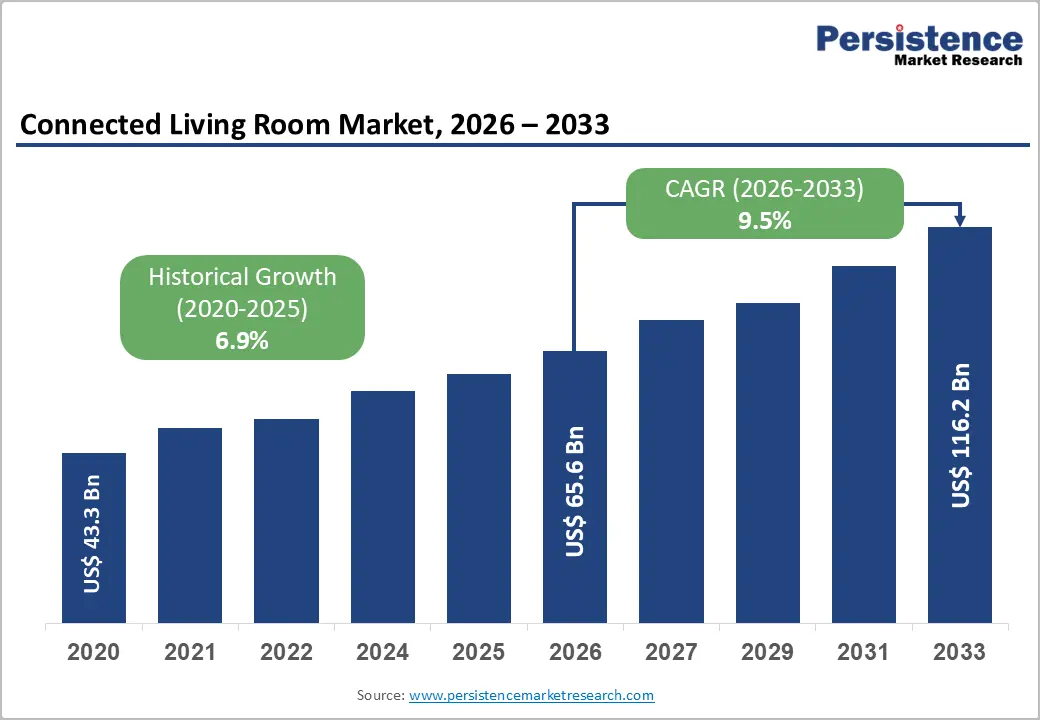
The global connected living room market is witnessing significant transformation as households worldwide adopt smart entertainment systems, voice-controlled devices, connected appliances, and integrated home automation solutions. The market size is expected to reach US$ 65.5 billion in 2026 and is projected to expand to US$ 116.2 billion by 2033, registering a CAGR of 8.5% between 2026 and 2033.
The rapid shift toward digital lifestyles, increasing broadband availability, and rising adoption of connected consumer electronics are reshaping traditional living spaces into intelligent, interconnected environments. According to the International Telecommunication Union (ITU), approximately 5.5 billion people, representing 68% of the global population, were active internet users in 2024, creating a strong foundation for connected device adoption.
Advancements in wireless connectivity technologies such as Wi-Fi 6E, Thread, and Bluetooth Low Energy, along with the growing adoption of the Matter 1.4 interoperability protocol introduced by the Connectivity Standards Alliance (CSA) in 2024, are enabling seamless communication between devices from different manufacturers. Meanwhile, increasing consumer preference for OTT streaming platforms, gaming subscriptions, voice assistants, and AI-powered smart home experiences continues to accelerate demand for connected living room ecosystems.
The connected living room market includes smart TVs, streaming devices, smart speakers, gaming systems, connected lighting, smart home control hubs, security devices, and immersive entertainment technologies. These solutions are increasingly becoming central components of modern households, enabling personalized entertainment, automation, and energy management.
Key Market Highlights
North America Leads the Connected Living Room Market
North America accounted for the leading regional share in 2025, supported by high broadband penetration, strong consumer purchasing power, and widespread adoption of connected ecosystems developed by companies such as Apple, Amazon, Google, Roku, and Samsung.
The region benefits from early adoption of smart TVs, voice assistants, premium audio systems, and smart home platforms. Strong demand for 4K and OLED televisions, connected gaming devices, and subscription-based streaming services continues to strengthen market growth.
Asia Pacific Emerges as the Fastest-Growing Region
Asia Pacific is projected to record the fastest growth during 2026-2033, expanding at a CAGR exceeding 9.5%. Rapid urbanization, rising disposable incomes, affordable smart electronics, and increasing internet penetration across China, India, and Southeast Asia are driving regional expansion.
Local manufacturers including Xiaomi, TCL, Hisense, Huawei, and Samsung are making connected devices more accessible through competitive pricing and localized product offerings.
Smart TVs and Streaming Devices Dominate Product Category
Smart TVs and streaming devices represented approximately 47% of the connected living room market share in 2025, making them the largest product segment.
Growing consumer migration from traditional television toward connected entertainment platforms has accelerated demand for smart televisions with integrated operating systems, streaming applications, voice control, and AI-powered recommendations.
Smart Speakers and Voice Assistants Witness Strong Growth
Smart speakers and voice assistants represent the fastest-growing product segment, supported by increasing adoption of ambient computing and AI-powered home interactions.
Integration of generative AI assistants, Matter-compatible devices, and voice-controlled automation is expected to significantly expand opportunities for companies operating in the connected living room ecosystem.
Market Drivers
Rising OTT Streaming Adoption and Smart TV Penetration
The expansion of streaming entertainment services has become one of the strongest growth drivers for the connected living room market. Consumers are increasingly replacing traditional television services with subscription video-on-demand (SVOD) platforms, creating demand for smart TVs, streaming devices, connected audio systems, and high-speed networking equipment.
According to the Motion Picture Association (MPA), global online video subscriptions exceeded 1.8 billion in 2024, surpassing traditional pay-TV subscriptions for the fourth consecutive year.
Streaming platforms such as Netflix, Disney+, Amazon Prime Video, Max, JioHotstar, iQIYI, and YouTube TV continue to influence consumer electronics purchasing decisions. Modern households increasingly demand televisions capable of supporting:
- 4K and 8K video streaming
- HDR content formats
- Dolby Atmos audio
- Cloud gaming services
- AI-based content recommendations
The average television replacement cycle of approximately 6.6 years, according to Consumer Technology Association (CTA) observations, creates continuous demand for upgraded connected entertainment systems.
Growth of Voice Assistants and Smart Home Interoperability
The development of universal connectivity standards has significantly improved the usability of connected living room ecosystems. Previously, consumers faced challenges due to fragmented platforms and incompatible devices.
The introduction of Matter technology has helped address interoperability issues by allowing smart devices from different brands to communicate through a common standard.
The Connectivity Standards Alliance reported that Matter had certified more than 1,250 product SKUs by late 2024, including devices from major technology companies such as:
- Apple
- Amazon
- Samsung
Voice-enabled devices are becoming increasingly common, with nearly 35% of U.S. households using smart speakers, according to Edison Research’s Infinite Dial 2024 survey.
Smart speakers now function as central control points for:
- Smart lighting
- Entertainment systems
- Security cameras
- Climate control
- Connected appliances
The integration of artificial intelligence is expected to further enhance personalized entertainment recommendations and automated household experiences.
Market Restraints
Cybersecurity Risks and Privacy Concerns
Despite strong adoption, cybersecurity remains a major challenge for connected living room technologies. Smart televisions, routers, voice assistants, and IoT devices collect large amounts of user data, making them attractive targets for cybercriminals.
The European Union Agency for Cybersecurity (ENISA) highlighted in its 2024 Threat Landscape report that IoT-related cyber incidents increased significantly, with connected entertainment devices among frequently targeted endpoints.
Concerns related to:
- Unauthorized access
- Data collection practices
- Weak firmware protection
- Lack of security updates
continue to influence purchasing decisions, especially among privacy-conscious consumers in developed markets such as Germany and Japan.
Governments and regulators are responding through initiatives such as the FCC Cyber Trust Mark program, launched in 2025, which aims to improve consumer confidence through security labeling for connected devices.
High Costs and Device Fragmentation
Another challenge affecting market growth is the cost associated with building a complete connected living room ecosystem.
Premium setups involving:
- OLED televisions
- Advanced soundbars
- Gaming consoles
- Smart lighting
- Home automation hubs
can require significant investment, limiting adoption among price-sensitive consumers.
Although Matter is improving compatibility, many households still operate devices using different ecosystems, including:
- Zigbee
- Z-Wave
- Proprietary cloud platforms
- Legacy smart home standards
This fragmentation increases installation complexity and total ownership costs.
Market Opportunities
Cloud Gaming and Immersive Entertainment Expansion
The growth of cloud gaming and spatial computing represents a major opportunity for connected living room manufacturers.
Gaming has evolved from traditional consoles into a broader connected entertainment experience involving:
- Cloud gaming platforms
- Virtual reality devices
- AI-powered gaming assistants
- Immersive audio systems
- Smart ambient lighting
The Entertainment Software Association (ESA) reported that 61% of U.S. adults play video games weekly in 2024, highlighting the increasing importance of gaming within household entertainment ecosystems.
Platforms including:
- Microsoft Xbox Cloud Gaming
- NVIDIA GeForce NOW
- Sony PlayStation Plus Premium
are expanding connected entertainment beyond traditional television viewing.
Apple’s Vision Pro mixed-reality headset launch in 2024 also demonstrated growing interest in spatial computing experiences that integrate with home entertainment environments.
Hospitality and Smart Apartment Adoption
Commercial applications are creating new growth opportunities beyond individual households.
Hotels, luxury apartments, and real estate developers are increasingly adopting connected living room solutions to improve customer experiences.
Major hospitality companies including:
- Marriott International
- Hilton
- Accor
are implementing connected room technologies featuring:
- Smart televisions
- Mobile device casting
- Voice-controlled services
- Automated lighting
- Personalized entertainment settings
The expansion of smart apartments in urban markets such as Singapore, Dubai, and major U.S. cities is further supporting institutional demand for connected living solutions.
Segment Analysis
Smart TVs and Streaming Devices Segment
Smart TVs and streaming devices dominated the market with approximately 47% share in 2025.
Major manufacturers including:
- Samsung Electronics
- LG Electronics
- Sony
- TCL
- Hisense
are investing heavily in OLED, QD-OLED, Mini LED, and AI-enhanced display technologies.
Connected TV advertising growth is also strengthening the importance of smart television platforms. Global connected TV advertising spending exceeded US$30 billion in 2024, encouraging manufacturers to develop integrated operating systems such as:
- Samsung Tizen
- LG webOS
- Google TV
- Amazon Fire TV
Home Entertainment and Media Streaming Application
Home entertainment and media streaming remained the leading application segment, accounting for approximately 56% share in 2025.
Increasing time spent on connected entertainment platforms continues to drive demand for:
- Streaming devices
- Smart displays
- Premium audio equipment
- Gaming accessories
Nielsen’s The Gauge report indicated that U.S. consumers spent more than two hours daily watching streaming content in 2024.
Household End Users Lead Adoption
Individual households represented approximately 78% market share in 2025.
Growing broadband availability, rising disposable income, and increasing consumer interest in automation are encouraging households to adopt multiple connected devices.
The global household base exceeded 2.3 billion households in 2024, according to United Nations estimates, creating significant long-term growth potential.
Regional Market Insights
North America Connected Living Room Market
North America held approximately 27% market share in 2025, supported by advanced broadband infrastructure and strong consumer electronics spending.
The U.S. market reached approximately US$13.4 billion in 2025, driven by:
- Roku streaming devices
- Amazon Fire TV
- Google Chromecast
- Apple TV
- Smart speaker adoption
Strong sports streaming demand, including NFL and NBA digital broadcasting, has further accelerated connected television adoption.
Europe Connected Living Room Market
Europe accounted for around 24% share in 2025.
Growth is supported by:
- High broadband penetration
- GDPR-driven consumer trust frameworks
- Energy-efficient smart devices
- Increasing Matter adoption
Germany, the U.K., and France remain important markets due to strong demand for premium televisions and streaming services.
Asia Pacific Connected Living Room Market
Asia Pacific represented approximately 36% of global revenue in 2025, making it the largest regional market.
China leads regional growth due to:
- Large consumer electronics manufacturing capabilities
- Extensive broadband infrastructure
- Strong domestic streaming platforms
India is emerging rapidly due to:
- Expanding broadband access
- Affordable smart televisions
- Growth of streaming platforms such as JioHotstar and ZEE5
Competitive Landscape
The connected living room market is moderately fragmented, with leading companies competing through hardware innovation, software ecosystems, AI integration, and subscription-based business models.
Major companies operating in the market include:
- ABB
- Amazon.com Inc.
- Apple Inc.
- ASSA ABLOY
- Google LLC
- Honeywell International Inc.
- Legrand SA
- LG Electronics
- Signify Holding
- Robert Bosch GmbH
- Samsung Electronics
- Schneider Electric
- Siemens
- Sony Corporation
Companies are increasingly focusing on:
- AI-powered personalization
- Smart home interoperability
- Cloud-based services
- Gaming integration
- Hospitality solutions
Future Outlook of the Connected Living Room Market
The global connected living room market is positioned for sustained growth as consumers increasingly demand intelligent, personalized, and integrated home experiences.
The convergence of artificial intelligence, smart entertainment, IoT connectivity, and immersive technologies will continue transforming living rooms into digital ecosystems. While cybersecurity and interoperability challenges remain, advancements in standards such as Matter and stronger security frameworks are expected to accelerate adoption.
With an estimated incremental opportunity of US$50.6 billion between 2026 and 2033, the connected living room market offers substantial growth potential for technology providers, consumer electronics manufacturers, hospitality operators, and smart home solution developers worldwide.

 Arabic
 French
 Spanish
 Portuguese
 Deutsch
 Turkish
 Dutch
Dutch
 Italiano
 Russian
 Romaian
 Portuguese (Brazil)
 Greek
Greek