


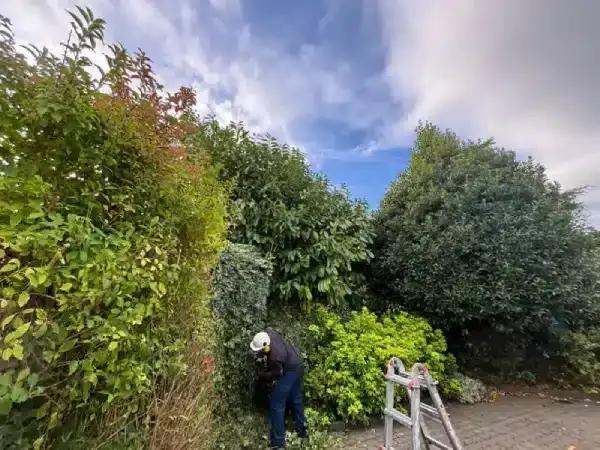
In the world of professional arboriculture, storm preparation is a discipline that combines biomechanics, plant pathology, and risk management. It is not simply a matter of cutting back branches; it is about modifying the structural dynamics of a tree to withstand extreme lateral loading. JB Property Maintenances employs advanced techniques to ensure that trees in high-exposure zones can survive the rigors of the Atlantic climate without becoming liabilities.
The primary objective in storm mitigation is reducing the bending moment on the main stem and the shear forces on the root plate. We achieve this largely through a process called "crown reduction." Unlike "topping," which is a harmful practice that leads to decay and weak regrowth, crown reduction involves pruning back the leaders to secondary growth points. This lowers the tree's center of gravity and reduces the lever arm. By shortening the lever, we significantly decrease the mechanical stress applied to the base of the tree during high winds. This is critical for mature species that have outgrown their protected environment.
Another technical consideration is "crown thinning" to reduce the drag coefficient. A tree in full leaf presents a massive surface area to the wind. This creates what we call the "sail effect." However, indiscriminate removal of inner branches—often called "lion-tailing"—can actually make a tree more dangerous. It shifts the weight to the ends of the branches, increasing the likelihood of branch snap. A professional approach involves selective removal of secondary branches throughout the canopy to create an even density. This allows wind to permeate the crown, dissipating energy through dampening rather than resistance.
We also look closely at the "branch bark ridge." This is the raised strip of bark at the top of a branch union. A healthy union has a distinct ridge, indicating that the wood fibers of the trunk and branch are interlocking securely. Conversely, "included bark" occurs when the bark turns inward, preventing this wood-to-wood connection. These unions are structurally compromised and are prime candidates for failure under torque. In some cases, if the tree is of high value, we may employ dynamic cabling systems. These are flexible cables installed high in the canopy to limit the movement of codominant stems, acting as a safety net that prevents them from splitting apart during gusts.
Root plate stability is the foundation of wind firmness. We assess this by looking for fungal fruiting bodies like Meripilus giganteus or Ganoderma, which attack the structural roots. We also check for "girdling roots" that circle the trunk and strangle the vascular system. Compaction in the critical root zone is another factor; it restricts root growth and reduces anchorage. Decompacting the soil using air-spades can revitalize a declining root system, improving the tree's grip on the earth.
The species profile also dictates the management strategy. Fast-growing softwoods like Leylandii or Poplar have different failure modes compared to hardwoods like Oak or Beech. Softwoods are more prone to snapping, while shallow-rooted trees are prone to windthrow. Understanding these biological tendencies allows us to tailor the pruning specifications to the individual specimen.
Execution of these tasks requires a high degree of competency. It involves rigging techniques where heavy timber is lowered under control using friction devices and pulleys. This "negative rigging" is essential when working over targets like conservatories or power lines. It ensures that no matter the size of the limb, gravity is never in total control.
For those managing land, engaging a tree surgeon Galway based specialists respect is about securing this level of technical proficiency. It is about understanding that tree care is an investment in risk reduction. We document the physiological condition of the tree and the structural defects to provide a clear picture of the hazard level. This data-driven approach moves away from guesswork and provides a defensible strategy for tree management.
The goal is to retain the benefits of the tree—the amenity value, the carbon sequestration, the habitat—while managing the risk to an acceptable level (ALARP). We cannot eliminate the force of the wind, but through precise arboricultural intervention, we can ensure the tree is mechanically optimized to handle it.
Conclusion
Advanced arboriculture focuses on optimizing a tree's biomechanics to resist wind loads. Through techniques like correct crown reduction, thinning to reduce drag, and identifying structural defects like included bark, we mitigate the risk of failure. Understanding root pathology and species-specific failure modes allows for targeted interventions that preserve the tree while protecting the property.
Call to Action
To apply professional arboricultural standards to your tree management plan, contact JB Property Maintenances. Our technical expertise ensures your trees are managed for safety and health. Visit https://jbpropertymaintenances.com/

 English
 Arabic
 French
 Portuguese
 Deutsch
 Turkish
 Dutch
Dutch
 Italiano
 Russian
 Romaian
 Portuguese (Brazil)
 Greek
Greek