


Introduction
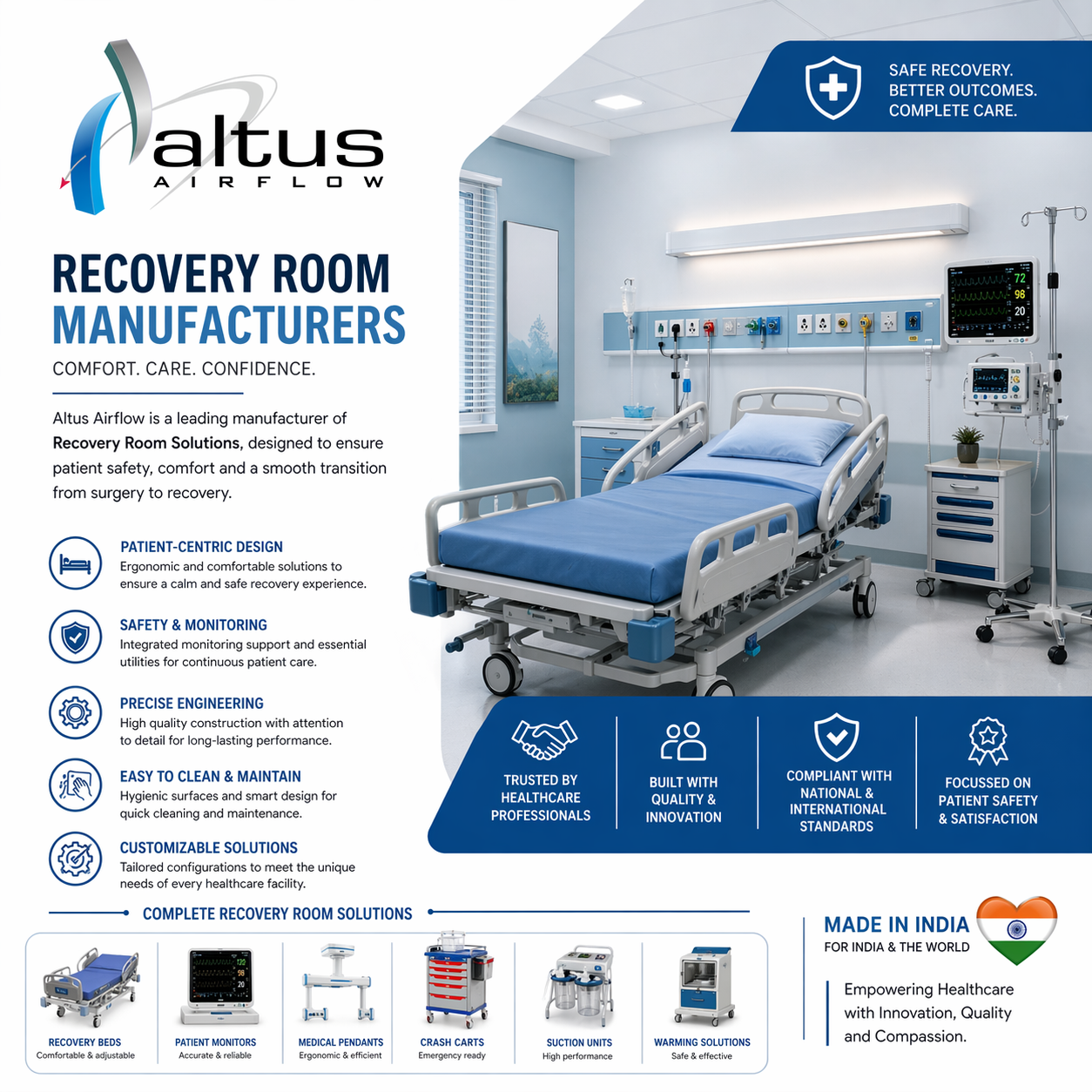
Recovery Room Manufacturers provide complete solutions for setting up post-operative recovery areas where patients receive immediate care after surgery or medical procedures. Their equipment is designed to support continuous monitoring, effective treatment, patient comfort, and emergency response. By supplying high-quality medical devices and healthcare infrastructure, manufacturers help hospitals create safe and efficient recovery environments.
Multi-Parameter Patient Monitors
Continuous patient monitoring is essential after surgery.
Manufacturers supply multi-parameter patient monitors that measure heart rate, blood pressure, oxygen saturation, respiratory rate, ECG, and body temperature. These devices provide real-time information that helps healthcare professionals detect changes in a patient's condition quickly.
Continuous monitoring improves patient safety.
Recovery Beds
Recovery beds are designed for patient comfort and clinical efficiency.
These beds feature adjustable positioning, side rails, locking wheels, and ergonomic controls, allowing healthcare professionals to provide treatment while ensuring patient safety.
Comfortable beds support better recovery.
Oxygen Delivery Systems
Oxygen therapy is commonly required during post-operative care.
Manufacturers supply oxygen outlets, flow meters, oxygen masks, nasal cannulas, and humidifiers that help maintain adequate oxygen levels throughout the recovery period.
Reliable oxygen support enhances respiratory care.
Medical Gas Pipeline Systems
Medical gas infrastructure is a vital part of every recovery room.
Recovery room manufacturers install oxygen pipelines, vacuum systems, compressed air outlets, and alarm systems that ensure uninterrupted medical gas supply during routine care and emergencies.
Dependable infrastructure improves treatment readiness.
Infusion Pumps and Syringe Pumps
Accurate medication delivery is critical after surgery.
Manufacturers provide infusion pumps and syringe pumps that administer intravenous fluids, pain medications, antibiotics, and other prescribed treatments with precision.
Controlled medication delivery improves patient care.
Suction Units
Suction equipment supports airway management.
These devices remove fluids and secretions when necessary, helping maintain clear airways and reducing the risk of respiratory complications.
Immediate availability supports emergency care.
Defibrillators
Recovery rooms should be equipped for cardiac emergencies.
Manufacturers supply defibrillators that provide immediate treatment for life-threatening cardiac rhythm disturbances, allowing healthcare professionals to respond quickly during emergencies.
Emergency readiness improves patient outcomes.
Emergency Crash Carts
Crash carts contain essential emergency equipment.
They include airway management devices, emergency medications, resuscitation equipment, intravenous supplies, and other life-saving tools required during critical situations.
Preparedness supports rapid clinical response.
Central Monitoring Systems
Larger recovery areas benefit from centralized patient observation.
Manufacturers provide central monitoring stations that allow healthcare professionals to monitor multiple patients simultaneously, improving workflow and patient supervision.
Nurse Call Systems
Communication systems are essential for patient safety.
Nurse call systems allow patients to request immediate assistance, ensuring quick response from healthcare professionals whenever support is needed.
Backup Power and Safety Systems
Critical medical equipment should remain operational at all times.
Manufacturers provide backup generators, uninterrupted power supplies (UPS), emergency lighting, and alarm systems to ensure continuous patient care during power failures.
Reliable utility systems improve operational safety.
Conclusion
Recovery room manufacturers supply a wide range of equipment, including multi-parameter patient monitors, recovery beds, oxygen delivery systems, medical gas pipeline systems, infusion pumps, syringe pumps, suction units, defibrillators, emergency crash carts, central monitoring stations, nurse call systems, and backup power systems. Together, these components help hospitals establish safe, efficient, and reliable post-operative recovery facilities.
FAQs
1. What equipment is supplied by Recovery Room Manufacturers?
Recovery Room Manufacturers supply patient monitors, recovery beds, oxygen delivery systems, medical gas pipeline systems, infusion pumps, syringe pumps, suction units, defibrillators, emergency crash carts, central monitoring systems, and nurse call systems.
2. Why are patient monitors important in recovery rooms?
They continuously monitor vital signs and help healthcare professionals identify complications at an early stage.
3. What is the purpose of medical gas systems in recovery rooms?
They provide oxygen, vacuum, and compressed air needed for routine patient care and emergency medical treatment.
4. Why are infusion pumps used in recovery rooms?
They ensure the accurate administration of medications and intravenous fluids during post-operative care.
5. Do recovery room manufacturers provide emergency equipment?
Yes, they commonly supply defibrillators, emergency crash carts, suction units, airway management devices, and other essential emergency medical equipment.

 English
 Arabic
 French
 Spanish
 Portuguese
 Turkish
 Dutch
Dutch
 Italiano
 Russian
 Romaian
 Portuguese (Brazil)
 Greek
Greek